

Sometimes, the hardest part of receiving love is believing it will still be there tomorrow.
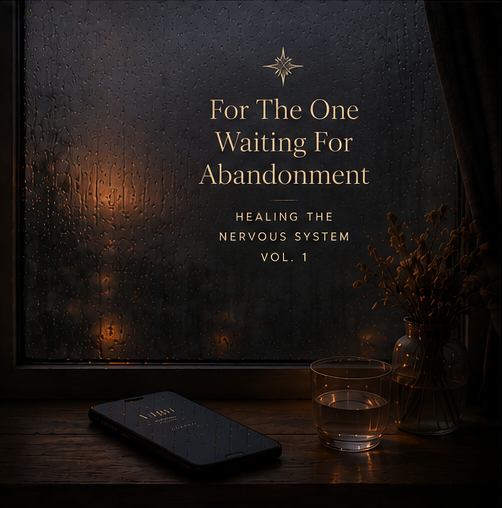
A song for the part of you still bracing for goodbye
This letter is for the one who watches for distance, studies every change in tone, and quietly prepares for the moment love disappears. Press play when you need a reminder that fear is not always a warning. Sometimes, it is an old wound remembering what happened before.
Listen to Letter 3You may not call it waiting for abandonment.
You may call it being observant. Being realistic. Protecting yourself. Staying prepared so that nothing can catch you off guard again.
But somewhere beneath the careful watching, there may be a part of you expecting everyone you love to eventually leave.
It listens closely when their voice sounds different. It notices when a message takes longer than usual. It studies the space between words and searches for signs that something has changed.
Even during moments of closeness, this part of you may struggle to relax. Instead of fully receiving the love in front of you, it quietly asks, “How long will this last?”
You learned to prepare before you learned to trust
Waiting for abandonment is not always about believing you are unlovable. Sometimes, it comes from learning that love can be unpredictable.
Perhaps affection was available one day and withdrawn the next. Perhaps someone promised to stay but left when you needed them most. Perhaps you became accustomed to relationships in which safety could disappear without warning.
Experiences like these can teach the nervous system to remain alert even when the present moment is calm.
Your mind may understand that a new person is not the person who hurt you. Your body, however, may still remember how quickly connection once became loss.
So it prepares.
It creates emotional distance before anyone else can. It imagines the ending while the relationship is still unfolding. It searches for proof that the goodbye has already begun.
Hypervigilance can make love feel temporary
When your nervous system expects abandonment, ordinary changes can feel much larger than they are.
A delayed reply may feel like rejection. A tired expression may feel like disinterest. A request for space may feel like the beginning of the end.
The fear can become so strong that you begin reacting to what might happen instead of what is actually happening.
You may ask repeated questions, search for hidden meanings, withdraw before the other person can withdraw, or test whether they truly care. You may need closeness and then feel frightened once it is offered.
None of this means you are incapable of healthy love. It means your protective system learned to associate attachment with uncertainty.
It is trying to prevent another loss by detecting it early.
The problem is that constant preparation cannot prevent heartbreak. It only prevents you from fully experiencing the connection that exists right now.
Not every quiet moment is a goodbye
Healing may begin with learning to pause before treating fear as fact.
When the familiar alarm rises, you can gently ask yourself:
“What do I know right now, and what am I predicting?”
“Has this person actually withdrawn, or has something activated an older fear?”
“Can I ask for clarity instead of silently preparing for loss?”
This is not about ignoring genuine warning signs or convincing yourself to remain in unsafe relationships. It is about noticing the difference between present evidence and old emotional memory.
Safe relationships still include busy days, misunderstandings, changing moods, difficult conversations, and moments of space. Consistency does not mean constant availability. Love can remain intact even when every moment does not feel perfectly connected.
You do not have to leave yourself first
Sometimes, the fear of being abandoned causes you to abandon yourself.
You silence your needs so you will not seem demanding. You tolerate uncertainty without asking questions. You reshape yourself into whoever you believe the other person is least likely to leave.
You may focus so intensely on keeping the relationship that you stop asking whether the relationship is also caring for you.
But your safety cannot depend entirely on another person’s decision to stay.
Part of healing is becoming someone you can rely on, even when relationships change.
You can promise yourself that you will listen when something feels wrong. You will communicate instead of disappearing inside your fear. You will not betray your values to avoid rejection. You will remain present with yourself whether someone stays or goes.
The goal is not to guarantee that you will never experience loss again. No relationship can offer that guarantee.
The goal is to know that loss would not erase you.
You are allowed to experience what is here
You do not have to grieve every relationship before it ends.
You do not have to rehearse every possible goodbye to prove that you are prepared.
You do not have to search for the ending while someone is still choosing to be present with you.
You can let today be today.
You can receive the message, the kindness, the effort, the conversation, and the affection without forcing them to answer every question about the future.
Trust does not require you to believe that nothing painful will ever happen. Trust can simply mean allowing the present moment to be real before fear rewrites it.
To the one still waiting
I know part of you is still listening for the door.
I know you notice every pause and every change. I know how quickly your body begins preparing for a loss that has not happened.
But you are no longer powerless inside that fear.
You can pause. You can breathe. You can ask for reassurance. You can examine what is true. You can remain connected to yourself instead of chasing certainty that no human relationship can completely provide.
Some people may leave. Some relationships may change. But not every pause is abandonment, not every disagreement is rejection, and not every quiet moment is the beginning of goodbye.
There are people who can communicate, repair, return, and remain consistent.
There is love that does not require you to live in constant preparation for its disappearance.
And slowly, with time and repeated safety, your nervous system can learn that it no longer has to stand at the edge of every good thing waiting for it to end.
Leave a Reply